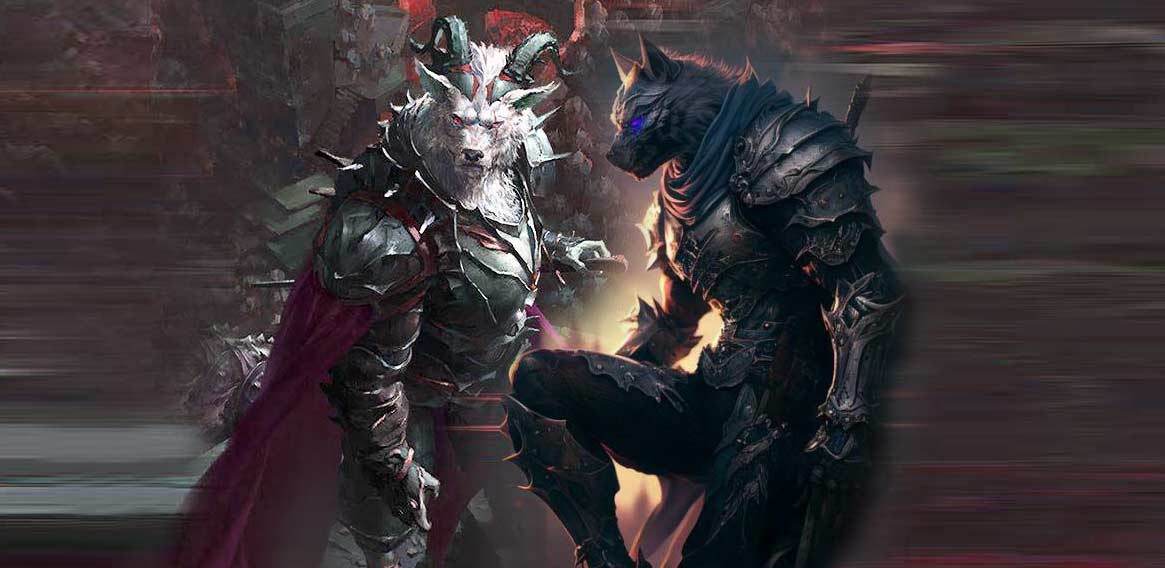
The Wulfurians were a bestial, canine-like humanoid race, native to the untamed Wildlands of Eos. They were divided into two distinct biological lineages: the Grey and the Jeckel. These humanoid creatures walked a precarious line between light and darkness, their choices often reflecting both. Many Wulfurians were considered Neutral Evil, aligning themselves with other malevolent factions such as the intelligent, but ruthless Skel or the savage and wicked Droogas.
Description
Wulfurians resembled other bestial humanoids, combining human and animal features into a striking hybrid. Standing tall, often exceeding six feet in height, they carried the stature of a human but with unmistakable animalistic traits. Though their forms were generally humanoid, their heads bore the likeness of wild beasts, much like the Pantheras or Ravan Birchal. Fur covered their muscular bodies, giving them an imposing presence. Their human-like hands were dexterous but tipped with claws, while their feet were broad and powerful, suited for both speed and endurance. The most striking feature of the Wulfurians, however, was their canine traits. Whether they took on the appearance of wolves or resembled the fierce jeckel hounds, their animal instincts were evident in every aspect of their behavior.
Grey Wulfurians
The Grey Wulfurians were the most imposing of their kind, resembling a fearsome fusion of human and wolf. Their eyes glowed with an almost supernatural light, and their powerful bodies exuded raw strength. Unlike the Jeckel, the Greys were marked by the large, curling horns that protruded from their skulls—dark and menacing, reminiscent of some long-forgotten, savage deity. These horns, combined with their elongated muzzles and sharp, predatory fangs, made them formidable opponents in battle.
medium
6'4"
beastial humanoid
80 years
true neutral
animas pantheon
all
grey, jeckel
Jeckel Wulfurians
The Jeckel Wulfurians, while smaller in stature than their Grey counterparts, were no less dangerous. They lacked the horns that defined the Greys, but their shorter snouts and more compact, wolf-like ears gave them a distinctly cunning appearance. Their features, though less imposing, allowed them to blend into the shadows more easily, making them skilled hunters and ambushers. Where the Greys relied on brute force, the Jeckel favored speed and precision.
Animas Pantheon
Wulfurians held deep reverence for the ancient beast gods of the Animas Pantheon. These deities, said to embody the primal forces of nature, were worshipped through rites and rituals that echoed the wildness of the creatures themselves. Wulfurians believed that their gods granted them the strength and cunning of the animals they resembled, drawing power from the very essence of the Wildlands.
Regions
Wulfurians roamed the Wildlands, with the greatest concentrations found in the regions of Hauth, T’ssara, and southern Zor. These lands suited their druidic way of life, far from the bustling cities and towns of more civilized races. Preferring isolation, they made their homes in deep caverns, which they referred to as dens, or in tented villages sprawled across the flat plains. In forested areas, they constructed intricate wooden structures, woven with hide, to serve as small villages hidden beneath the canopy of trees. These settlements reflected their connection to the natural world, and they thrived in environments where they could remain close to the wild.
Most Wulfurians shunned heavily populated areas, feeling ill at ease in urban settings. Their druidic nature bound them to the rhythms of the earth, and they found solace in the untamed wilderness where their instincts could roam free.
History
Though capable of great intelligence, the Wulfurians lived for centuries guided by their primal instincts, with little need for written history or records. It wasn’t until roughly 300 MA that the Grey Wulfurians, in particular, began to rise beyond their wild nature. These groups began to form tight-knit packs, studying the ancient arts of druidic magic. This marked a turning point in their history, as they learned to harness the forces of nature not just for survival but for power. It was the beginning of their recorded history and the first steps of their people toward something greater than mere existence.