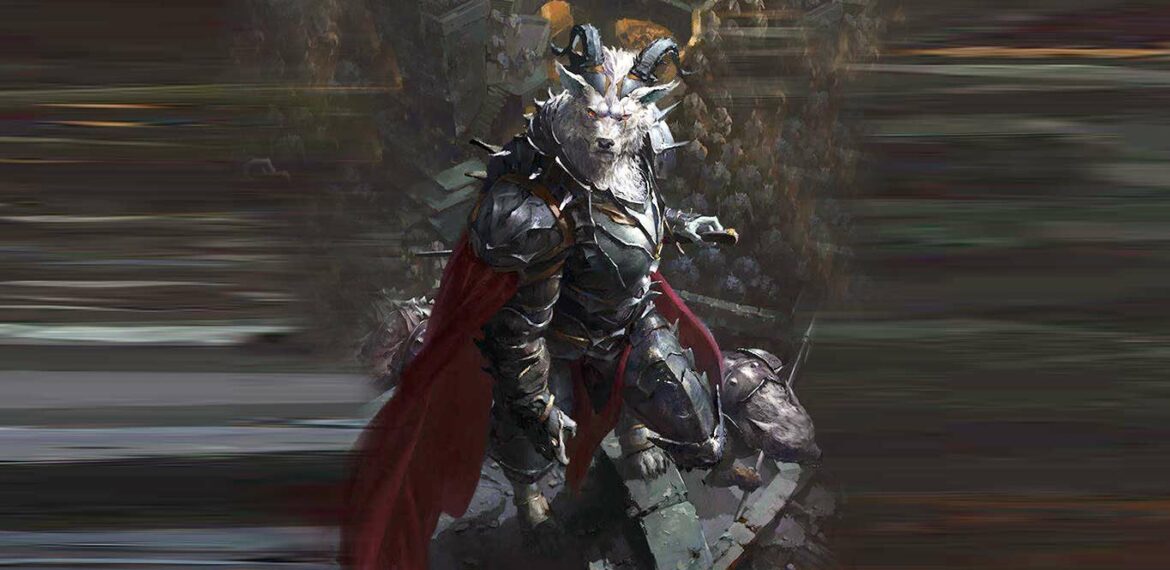
The Grey Wulfurians were a strong, brave, and aggressive subrace of the Wulfurian, one of the many bestial humanoid species native to the Wildlands. Though they were a minority among their kin, they were common enough to be found in various regions of the continent, except for the Blackwarg and the warmer tropical climates. The Grey Wulfurians originally hailed from the harsh southern tundra of present-day Antara, but over the centuries, they migrated to many parts of the continent, bringing their fierce reputation with them.
Description
Grey Wulfurians stood tall and powerful, their bodies resembling muscular, broad-shouldered humans, but their heads bore the striking resemblance of wolves. This fearsome combination made them both intimidating and majestic to behold. Two large, antler-like horns sprouted from their foreheads, curling upward and adding to their formidable appearance. Their entire bodies were covered in thick, dense fur, except for their hands and feet, which were bare, leathery, and tough. Most Grey Wulfurians had fur that ranged from shades of grey to white, with fewer having black or brown fur. Their eyes, glowing with intelligence and predatory instincts, were typically silver or blue, adding an icy, otherworldly air to their already menacing visage.
Tracking & Speed
Known for their keen sense of smell, Grey Wulfurians were exceptional trackers, able to detect and follow the scent of their prey for miles. They were also extraordinarily fast, able to outrun most humans with ease, their powerful legs propelling them across difficult terrains without slowing.

medium
6'2"
beastial humanoid
80-90 years
true neutral
pagan
varied
silver, blue
mountain, arctic, grassland, forest, marsh
Bite
Like their Jeckel Wulfurian cousins, Grey Wulfurians possessed a lethal bite. Their sharp, powerful jaws could tear through flesh and bone, and in combat, they skillfully combined their bite with melee weapons, making them fearsome opponents on the battlefield.
Cold Resistance
Due to their northern origins, Grey Wulfurians had developed a natural resistance to cold temperatures. Their thick fur protected them against the biting winds of their homeland, and they could endure extreme cold that would freeze lesser beings. This resistance also extended to cold-based magic, making them formidable foes for spellcasters who wielded ice or frost.
History
The origins of the Grey Wulfurians were rooted in the frozen, mountainous regions of southern Antara, ultimately migrating to northwest Zor. It was believed that in ancient times, long before recorded history, their ancestors migrated from the vast tundras to the rugged northern mountains to escape the encroaching dangers of the southern ice fields. These early Grey Wulfurians adapted to their new home, growing stronger, hardier, and more aggressive to survive in the unforgiving landscape. Over generations, they forged a culture of strength and resilience, revering the cold and the hunt, and gradually spreading their influence across the Wildlands.
Legend told of ancient tribal leaders who were said to have made pacts with the spirits of the land, granting the Grey Wulfurians their resilience and prowess in battle. They were skilled warriors, deeply in tune with the natural world around them. They believed the cold was a gift, a trial that forged them into superior beings. As their population grew, the Grey Wulfurians began to dominate the northern territories, pushing other subraces to the fringes of the Wildlands.
Kings of Leprus
In the Ancient Age, around 1400 AA, during the twilight of the reign of the Ancient Exarchs, three powerful Grey Wulfurian kings rose to prominence. They consolidated their forces and established the village of Leprus, nestled near the border of present-day Antara and Zor. Leprus became a bastion of Wulfurian strength and authority, ruled by the Grey Wulfurian monarchy. Though Jeckel Wulfurians also played significant roles in the governance of Leprus, their influence paled in comparison to that of the Grey, whose power had reached its zenith during this time.
The three kings forged an unbreakable pact that united their tribes under a single banner. This alliance, known as the “Grey Pact,” would last for five centuries, a time during which Leprus grew into a center of Wulfurian culture, trade, and military might. Grey Wulfurians were seen as the leaders of their race, their influence spreading far and wide across the continent. Warriors from Leprus were feared throughout the Wildlands, and the village became a symbol of Wulfurian dominance.
However, this golden age came to a brutal end in 908 AA, when the ancient Fyreburhl invaded Leprus. The ensuing conflict sparked decades of war, with epic battles fought across the region as the Wulfurians fiercely defended their homeland. The Invasion of Leprus marked the beginning of the end for the Grey Wulfurian monarchy. Though they fought valiantly, their numbers were decimated, and the once-mighty village of Leprus was reduced to ruins.
In the aftermath of the war, many Grey Wulfurians scattered across the continent. Some traveled south, seeking refuge in new lands, while others ventured into the eastern highlands. Over the centuries, their descendants spread far and wide, becoming a presence in nearly every region of the continent. Yet, despite their dispersion, they avoided the warmer savannah and tropical regions, which proved inhospitable to their cold-adapted nature.
Though the Grey Wulfurian empire of Leprus had long since fallen, their legacy endured, their fierce and proud heritage etched into the histories of the Wildlands.