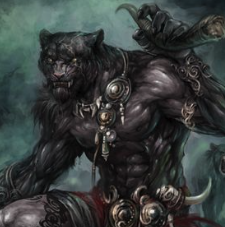
The Pantheras were among the most feared and reviled of the beastial races that stalked the Wildlands of Eos. Their origins were shrouded in ancient, half-forgotten myths, but all agreed that their bloodline was rooted in the primal essence of the great panther, a creature revered and feared in equal measure. Unlike their humanoid kin, such as the Wulfurians or the bird-like Ravan Birchal, the Pantheras possessed a unique blend of savage grace and dark, mystical prowess. They moved in the shadows of civilization, preferring the dense, untamed wilderness of Eos, where their dark rituals could remain undisturbed by the moralities of man.
Origins and Traits
The Pantheras traced their lineage back to ancient Vüdos and the surrounding sub-tropics, including the Acamiajem peninsula. Most were devote followers of the Animas Pantheon, a collection of ancient animal deities that embodied the raw forces of nature. Of these deities, the panther god Laeth was the most revered by the Pantheras, representing the night, stealth, and predatory instincts. Through Laeth’s blessings, their ancestors were said to have been born of shadow and blood, merging feline ferocity with humanoid intelligence. These gifts gave the Pantheras their distinct physical traits—a towering presence of nearly six feet, with lean, muscular bodies draped in sleek black fur. Their faces, an unsettling blend of human and panther, bore piercing golden eyes that seemed to glow with an inner, malevolent light.
medium
humanoid
75-90 years
typically evil
varied
all regions
common, katarish
pantheras, lynx
The Pantheras’ feline nature granted them agility and dexterity beyond any ordinary beast or human. Their movements were fluid, predatory, and almost supernatural, as though they glided across the ground with barely a whisper of sound. It was said that the Pantheras could track a victim for days, their padded feet leaving no trace, and strike from the shadows with terrifying precision. Their dark fur, slick and velvety, made them nearly invisible under the cover of night, and they could vanish into the gloom before their prey even realized the danger.
Keen Smell and Dark Magic
Like the panthers they resembled, the Pantheras had an extraordinary sense of smell. They could detect the scent of any beast or humanoid within a hundred feet, allowing them to hunt both animal and man with equal efficiency. This keen sense was not merely a tool for survival; it was a weapon, for they often used their heightened olfactory abilities in their sinister rituals. Blood sacrifices, a core element of their paganistic practices, required specific types of prey, and their senses allowed them to track the perfect victim to offer to Laeth or one of the lesser gods of the Animas Pantheon.
In their spirituality, the Pantheras embraced a form of animistic paganism that venerated not only the panther god Laeth but all creatures of the wild. Each Panthera saw themselves as an avatar of the primal forces of the jungle, but their faith had long since twisted into something dark. They practiced blood magic, a forbidden art in most of Eos, drawing power from the life essence of their sacrifices. Their rituals often involved summoning primal spirits from the Animas Pantheon, which they would bind to their will, corrupting nature itself to do their bidding. This connection to dark, bestial magic set them apart from other beastial races, and it was whispered that the Pantheras sought nothing less than dominion over the Wildlands through these cruel rites.
Stealth and Combat Prowess
Naturally skilled in stealth, Pantheras were masters of moving through dense forests and ruined cities without alerting their prey. They were said to be able to hide in plain sight, their bodies blending seamlessly into the shadows. This skill was invaluable in both hunting and combat, as they often ambushed their enemies, dispatching them with silent precision before slipping back into the darkness.
In battle, the Pantheras were terrifying foes. Their lithe, muscular bodies gave them extraordinary agility, and they could leap great distances, scaling walls or trees in seconds. They wielded a variety of weapons with deadly grace, from curved blades designed to slice through flesh and bone, to claw-like gauntlets that enhanced their already lethal natural weapons. Their strength and resilience made them formidable in close combat, and it was not uncommon for them to tear through an entire enemy line before anyone could react. Many Pantheras trained as barbarians, drawing upon their primal rage, while others favored the life of a rogue, striking from the shadows with unmatched cunning.
Clowders
Despite their individualistic and predatory nature, Pantheras were not solitary by any means. They organized themselves into tight-knit groups called Clowders. A Clowder functioned much like a guild, though its purpose was far more sinister. Within their ranks, Pantheras formed dark pacts, united by common goals, usually involving blood rituals, territory expansion, or the pursuit of forbidden knowledge. Each Clowder was tied to a Clowder House, a sacred and secretive place where they gathered to plot, perform their rituals, and share the spoils of their dark hunts.
Clowder Houses were usually hidden deep within the forests, constructed of wood and bone, and built high in the trees or deep underground, accessible only by ropes or concealed tunnels. These structures were designed to be both defensible and secretive, for Pantheras were often hunted by other races who feared their dark magic. Each house was a labyrinthine fortress, with multiple levels and chambers where the Pantheras stored their relics, conducted ceremonies, and prepared for war. It was in these Clowder Houses that Pantheras honed their skills in combat, learned the darker aspects of blood magic, and prepared for the day when they would spill out of the Wildlands and conquer the civilized world.
Propensity for Evil
There was no doubt that the Pantheras were drawn to darkness. Their entire existence was rooted in the violent, primal worship of the Animas Pantheon, and their rituals often required the blood of innocents. Unlike some other beastial races, who might fight for survival or honor, the Pantheras fought for domination, cruelty, and power. They delighted in the suffering of their enemies and often tortured captives in grotesque ceremonies to appease their gods.
Their propensity for evil was as natural to them as their feline grace. It was said that Pantheras could hear the whispers of their dark gods in the wind, urging them to give in to their baser instincts. They believed that through cruelty and bloodshed, they honored Laeth and would one day earn a place at his side, becoming demigods in their own right.
In the end, the Pantheras were not just a threat to the Wildlands, but to all of Eos. Their ambition knew no bounds, and as they continued to grow in power, the day would surely come when the shadow of the panther would fall upon the world, and none would be safe.