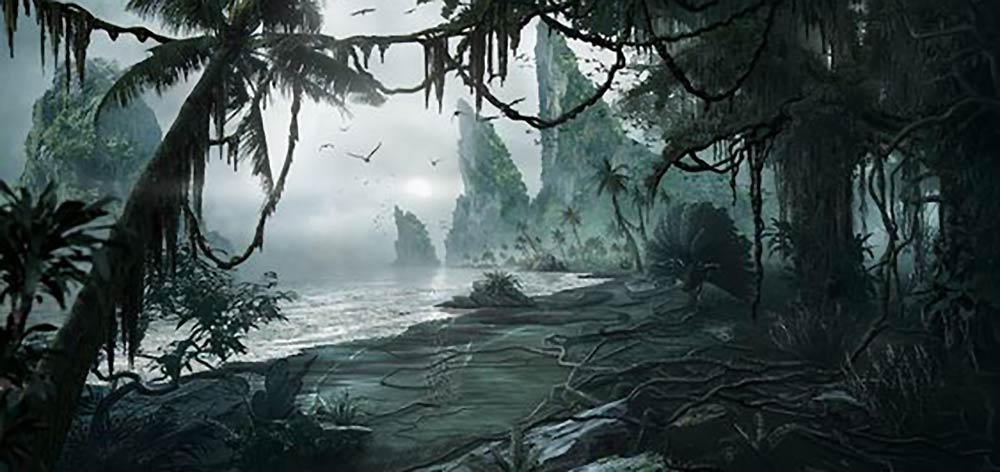
Acamiajem was a mysterious and foreboding peninsula on the southeastern edge of the nation of Streng, a land both revered and feared by those who knew of it. Its peculiarities began with the sky itself: unlike the rest of Streng, where skies were often clear, Acamiajem was cloaked in a veil of mist and slate-colored clouds that perpetually dimmed its strange magenta sun. Even at midday, sunlight filtered weakly through the thick gray, bathing the landscape in a muted, otherworldly glow. This gave the land an eerie, dreamlike quality, and cast its inhabitants and creatures in a ghostly hue.
Geography
The peninsula’s landscape, though subtropical and lush, stood in sharp contrast to the vibrant greens of surrounding regions. Acamiajem’s vegetation was pale and sickly, with shades of gray-green and bleached yellow covering the dense jungle. The roots of these plants intertwined into a dense web, forming nearly impenetrable thickets, and many species secreted toxic saps or bore poisonous thorns. Only the locals, a tribe known as the Kalfou (kahl-foo) Awasa, knew how to navigate the perilous foliage, skillfully avoiding the treacherous plants and the deadly creatures that lurked within.
The Kalfou Awasa were a dark and mysterious creed of humans, keepers of ancient secrets and masters of the mystical craft of Voodoo magic. They believed that Acamiajem was the birthplace of this magic, a power harnessed from the very soul of the land itself. Voodoo was no mere trick or illusion; it was a potent, ancient force, capable of bending reality to the caster’s will. Kalfou shamans practiced various forms of it, each branch with its own ominous purpose. There were spells for summoning storms, charms to poison a rival from afar, and rituals to bind spirits into fetishes that granted insight into the shadow world. Voodoo was as much a philosophy as it was a tool, emphasizing a connection to the peninsula’s untamed spirits, its hidden dangers, and its cycles of life and death.

Acamiajem
Streng
2,000
subtropical
awasa humans, birchal
dried meats, chimes, spices
village
none
Strange Beasts
The creatures of Acamiajem were as strange as the land. While many subtropical areas were home to dangerous animals, none compared to the ferocity of Acamiajem’s inhabitants. Its coastal cliffs and forests teemed with venomous snakes whose bites could induce delirium and cause hallucinations, a fact the Awasa had learned to exploit in their rituals. Giant spiders spun webs between twisted trees, their venom not only deadly but rumored to have properties useful in dark magic. Birds with glistening black feathers, known as Krawaks, were infamous for their aggressive behavior, sometimes attacking people without provocation. These birds were revered by the Awasa as spirit messengers, believed to carry the voices of ancestors and gods. Only the bravest—or perhaps the most reckless—dared to traverse the wilderness without an Awasa guide.
Inland, where the forest parted, lay Zulia Cay, an oceanic oddity that defied all reason. Encircled by a reef that acted as a natural barrier against the tide, Zulia Cay’s waters were eerily calm and shallow. Though accessible by boat, few willingly ventured near. The locals considered it a cursed place, a belief only reinforced by the desolate village that clung to its shores. This village, known by the same name, was a shadow of a town, almost as if suspended in time, with buildings in disrepair, their walls covered in salt-baked moss and algae. An unsettling silence permeated Zulia Cay, broken only by the occasional, haunting cry of a bird or the eerie rustling of wind through the abandoned houses. Legends told of people who entered Zulia Cay’s waters and disappeared without a trace, and of strange lights seen under the surface at night, flickering like submerged lanterns, as if something ancient and aware lingered in the depths.
For the Awasa, Zulia Cay was a sacred site, and the waters were considered a direct gateway to the world of spirits. It was said that the shaman could communicate with entities from beyond this world there, channeling the cay’s mysterious energy to unlock powerful and dangerous spells. Outsiders claimed that on certain nights, the Awasa shamans would row out to the cay, chanting in low voices and casting bones into the water as offerings, calling forth spirits to assist in their dark work.
Acamiajem, shrouded in secrets and mysteries, was both a cradle and an altar for the Awasa. It was a place where nature and magic intertwined in a sinister harmony, bound by the land’s ominous beauty and the enduring darkness within its people. It was a place to be respected, feared, and, for most, avoided altogether. For those who dared to enter Acamiajem’s borders, the price was often as steep as the knowledge gained was profound.
The Curse of the Voodoo Shaman
The Awasa shamans of Acamiajem held a fearsome reputation, and for good reason. Known for wielding powerful Voodoo curses, they often targeted well-known figures who dared to encroach on the land or disrespect its spirits. These curses—rumored to call upon malevolent forces from the spirit realm—led many of these individuals to untimely, often mysterious deaths. Skilled in the dark arts of necromancy, the shamans could even raise the dead, animating corpses as spectral servants. It was whispered that their darkest magic enabled them to speak directly with the deceased, extracting secrets from beyond the grave.