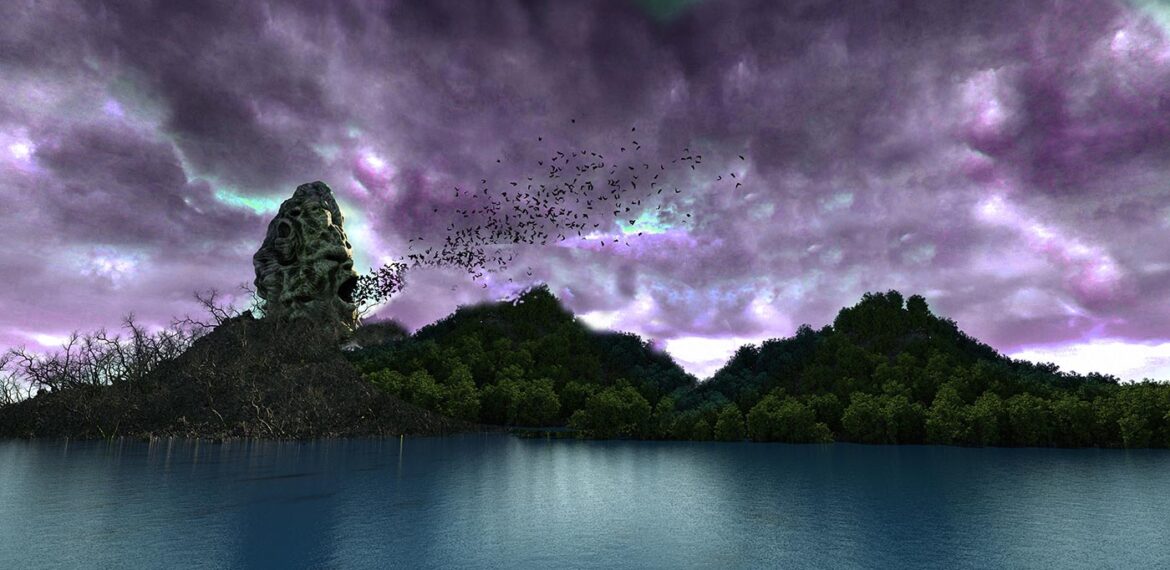
Knife Island, a subtropical gem off the coast of Streng in the Aquaris Sea, held a history as colorful and treacherous as its landscape. The island was 80 miles long and 22 miles across. Founded over seven centuries ago by Calypso Anaqua, along with a small mix of Atharion dara who were brought there for labor, as well as some Awasa humans, the island became a modest haven for those who settled there. The Calypso clan continued to thrive on the island, coexisting with Awasa humans who had also settled there, drawn by its secluded charm and strategic location.
The island’s terrain was a mix of lush jungles, craggy cliffs, and golden beaches. Yet, beneath its beauty lay dangers aplenty. Knife Island teemed with perilous wildlife, including giant serpents whose scales shimmered like liquid emeralds, dire bats with wingspans large enough to block out the sun, and stoneback lizards, whose armored hides rendered them nearly invulnerable to most weapons. Myths spoke of shadow tigers, phantom-like predators said to stalk the jungle with preternatural silence, vanishing into thin air after their strikes.
Skull Port
The island’s most prominent feature was Skull Port, a small, quaint harbor and the heart of trade and intrigue. The port derived its name from the massive, fifty foot tall stone head, with its mouth agape as if screaming, which rested on hillside that overlooked the bay. The monument was carved from a natural rock outcropping. The monument—both awe-inspiring and ominous—served as a warning to those who might approach uninvited. Legend claimed the head was once part of an ancient temple dedicated to Okru, the voodoo god of the moon, but it had later been defaced and repurposed as a symbol of defiance by Calypso Anaqua.

Knife Island
Aquarian Sea
80 miles long, 20 miles wide
4,000
subtropical
awasa humans, ravan birchal, calypso anaqua
democracy
Lord Voorus
Skull Port attracted a blend of merchants, pirates, and fugitives, forming a society held together by loose alliances and shared disdain for mainland authorities. The dwellings in the port and the surrounding villages were humble—ramshackle structures fashioned from wooden planks, salvaged tin, and an assortment of burlap and rope. Despite their rudimentary nature, these homes radiated a rough charm, their walls often adorned with faded flags, stolen relics, or carvings passed down through generations.
Knife Island’s shadowy reputation stemmed not only from its dangerous fauna but also its ties to Aquaris 1, a notorious crime faction operating throughout the sea. The island’s isolated nature and labyrinthine coves made it an ideal hideout for smugglers, raiders, and assassins. Whispers told of treasure caches buried deep within the jungle and secret sea caves accessible only at low tide. However, these same whispers warned of those who ventured in search of these treasures, never to return.
The Anaqua family maintained a tenuous hold on the island, their influence both revered and resented by its inhabitants. Though they no longer ruled with the iron will of their founder, they remained the de facto leaders, arbiters of disputes, and protectors against external threats. Yet, their position was increasingly challenged by rogue captains and ambitious pirates eager to claim the island’s riches for themselves.
Knife Island’s history was one of survival and adaptation. From its early days as Calypso Anaqua’s sanctuary to its current role as a hub for outlaws and adventurers, the island epitomized the wild spirit of the Aquaris Sea. Its jungles whispered of ancient secrets, its waters teemed with peril, and its people thrived in defiance of the world beyond their shores. It was a place where legends were born—and where the line between hero and villain was as thin as the island’s shimmering horizon.
Mambras Ore
Adding to the island’s grim mystique were the spirits of Mambras Ore, a clan of sinister Ravan Birchal pirates whose infamy spanned centuries. Eons ago, the Mambras Ore met a grisly end when a wave of black shadow magic swept over the islands, annihilating every member of the clan in a single, catastrophic event. According to legend, the spirits of the Mambras Ore did not depart the mortal plane but instead took the form of a flock of Dire Crows that has haunted the island ever since. Known locally as the Swarm of Mambras, these spectral birds were said to dwell in the yawning mouth of the stone-carved head at Skull Port.
By day, the crows would emerge in silent, ominous flight, their feathers black as the void and their eyes glowing faintly red. By night, their mournful caws echoed across the harbor, chilling the hearts of even the bravest souls. Some claimed that the Swarm of Mambras carried with them fragments of the dark magic that had ended their mortal lives, capable of cursing any who dared to harm them or disturb their resting place. Others spoke of visions—shadowy figures of pirates emerging from the flock, their spectral forms flickering like candle flames in the dark, eyes filled with malice.
The presence of the Swarm imbued the island with an air of dread, as locals and visitors alike avoided the skull’s mouth at all costs. Tales of sailors lured into the cavernous maw by whispers and ghostly lights were common, with few returning to tell the tale. Those who did spoke of shadowy tendrils creeping along the walls, phantom laughter, and the feeling of unseen hands clutching at their throats.
Despite the danger, some daring or foolish souls sought out the Swarm of Mambras, believing that the spirits guarded treasures hidden by the Mambras Ore in life. These treasure hunters often vanished without a trace, their fates adding to the growing legend of the cursed crows and the unholy magic that bound them to Knife Island. In time, the Swarm became both a symbol of the island’s haunted past and a warning to all who sought to claim its secrets for their own.