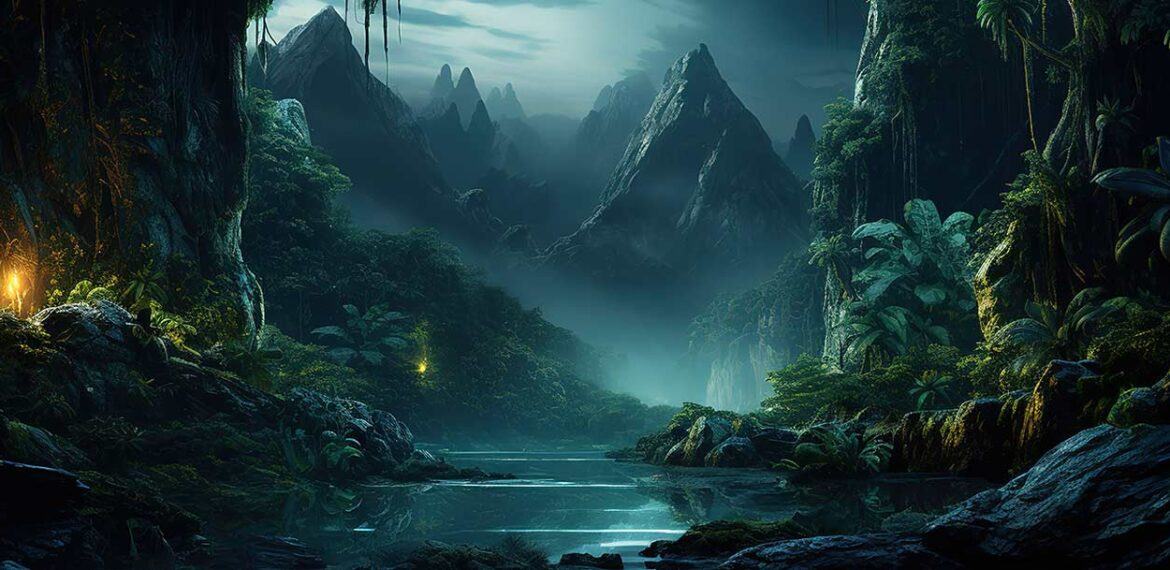
Vüdos was a land of striking contrasts, where the untamed beauty of nature met the pulse of a thriving nation-state, steeped in both mystique and maritime power. The landscape of Vüdos was a lush, subtropical paradise, a place where dense jungles met sprawling savannas, and where the scent of saltwater was never far from the air. Towering palm trees lined the coastlines, while deeper inland, ancient forests teemed with vibrant flora and fauna, some found nowhere else in the Wildlands. Rivers, fed by the frequent tropical rains, snaked through the jungles, creating a web of waterways that nourished the land and supported its flourishing wildlife.
The climate was warm and humid, with a magenta sun casting dim rays across a deep indigo, twilight sky. The wet and dry seasons were distinct; the rains came in torrents during the summer months, turning the rivers into swollen, roaring forces that fed the verdant jungle, while the dry season brought cooling breezes from the east, particularly along the coastlines. Along the shoreline, tranquil lagoons and azure waters contrasted with rugged cliffs and rocky outcrops that formed natural barriers, giving way to the wide-open, shimmering expanse of the Sunlit Sea. It was here, in these waters, that the people of Vüdos built their legacy as masters of the ocean.
Vüdos was as much a seafaring nation as it was a land of fertile fields and rich natural resources. Its history was one of oceanic exploration and naval might. The Vüdosi people, led by a line of powerful rulers and governed through a system of councils and high nobility, had long looked to the sea for opportunity. Over centuries, they carved their dominance across the Sunlit Sea and beyond. Their fleets were the most advanced in the known world, crafted from the strongest jungle wood and bolstered by magical enchantments drawn from the land’s deep connection to the natural world.
The Vüdos navy was famed not only for its technological prowess but for its legacy of conquest and trade. Its legendary admiralty, known as The Sea Lords, led daring expeditions that expanded Vüdos’s influence to distant lands, establishing colonies, forging alliances, and defeating rival navies in bloody battles upon the open ocean. Many cities along the coast bore the scars and triumphs of these naval campaigns—harbors filled with the spoils of war, trade goods from exotic realms, and stories of daring battles fought beneath the open sky.
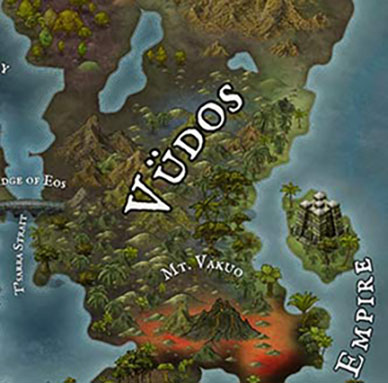
nation
mountains
anaqua, humans, aquaris gor, jurell
subtropical, savanna
1.1 million
Axelanah
ancient exarchs, pagan
textiles, ceramics, horses, lumber
chimes, cured fish, fruits, nuts, vegetables, palmas wood, conches, silk
At the heart of Vüdos’s maritime tradition was Seabaast, the eight-mile pier city that stood defiant against the sea itself. Built upon the shallow waters where Mt. Vekuo’s lava cooled into the ocean, Seabaast was both a port and a monument to Vüdosi ingenuity. It was from here that many of the great naval campaigns had been launched, and where the shipyards constantly buzzed with activity, constructing vessels capable of sailing farther than any other.
Governance in Vüdos was a careful balance between the high-born elite, known as The Sea-Blooded, whose ancestors had founded the nation, and the merchant guilds, whose trade routes across the Sunlit Sea sustained its wealth. The Council of the Tides, made up of the most influential nobles, traders, and military leaders, ruled over the daily affairs of the nation. But ultimate authority lay in the hands of the Wave Throne, the hereditary monarch who was seen as both the protector of Vüdos and its connection to the wild forces of nature.
The capital city, Damakos, perched atop the cliffs overlooking the Sunlit Sea, was a blend of tropical beauty and urban sophistication. Its gleaming white towers and grand palaces rose above the dense foliage, while its streets were a labyrinth of markets, guild halls, temples, and universities, filled with the hum of trade, diplomacy, and cultural exchange. At night, the city shimmered with the glow of bioluminescent lanterns, crafted from the native Titan Gloomross fungi, casting a soft violet and gold light that gave the capital an otherworldly aura.
But beyond its modern splendor, Vüdos was a land steeped in ancient traditions and mysticism. The Anaqua, the original inhabitants and spiritual guardians of the land, still held a sacred role within society, even as the nation-state grew into a powerful maritime empire. They served as druids, healers, and advisers to the ruling class, ensuring that the delicate balance between the land’s natural power and its political ambitions remained intact. Many believed that the very success of Vüdos’s navy and its seafaring prowess were due to the blessings of the Anaqua, whose rituals called upon the spirits of the sea and sky to guide and protect the nation’s fleets.
Vüdos’s history of conquest at sea was matched by its profound sense of exploration. Vüdosi sailors were renowned for their navigation skills and courage in venturing into unknown waters. They charted new islands, made first contact with distant peoples, and brought back not only wealth but knowledge that enriched their homeland. While many expeditions were born out of a desire for expansion and wealth, just as many were driven by curiosity and the desire to explore the farthest reaches of the world.
In Vüdos, the line between the natural and the urban, the mystical and the practical, blurred. It was a place where verdant jungles gave way to bustling cities, where the sea was both a provider and a battlefield, and where the spirit of adventure and conquest ran as deep as the roots of its towering trees.
The Anaqua
The anaqua were the dominant population in Vüdos, a race known for their strong ties to nature and the ancient energies that pulsed through the Wildlands. They lived in harmony with the lush subtropical landscape, cultivating the land and drawing upon the power of the natural world to shape their way of life. Many believed that the anaqua were descendants of the ancient stewards of the Wildlands, their lineage entwined with the very essence of the earth and sky.
The Bridge of Eos
The Bridge of Eos, constructed by the gor of T’ssara, was once the largest humanoid-made structure in all of the Wildlands. This colossal stone bridge stretched fifty-five miles across the T’ssara Strait, linking Vüdos to the western lands. The bridge was more than just a marvel of engineering; it was a lifeline for trade and travel, a vital artery connecting the distant lands. Built upon the bridge itself were castles, markets, homes, gardens, and even orchards, with some 8,000 souls making their home along its length. It was said that the bridge never slept, always teeming with the vibrant life of commerce, governance, and culture.
The Underway
Beneath the Bridge of Eos lay the Underway, a series of stone platforms initially created to support the massive structure above. Over time, these platforms became home to outcasts, drunks, beggars, and criminals fleeing from justice. Their makeshift tents and crude shelters clung to the shadows beneath the bridge, hidden from the world above. For many years, the bridge guards attempted to drive these squatters away, but they always returned, using hidden rope ladders to ascend to the main promenade whenever they could. It was a place where the law dared not linger long, and the Underway’s residents became a permanent, if unwanted, part of the bridge’s life.
Notable Locations
Axelanah
Axelanah was a serene village nestled amidst rolling hills, known for its orchards and tranquil riverbanks. It was a peaceful refuge for farmers and artisans, where time seemed to move slower than in the bustling cities beyond.
Damakos
Damakos was the heartbeat of the southern coast, a bustling port town where merchants from across the world gathered. Its markets brimmed with exotic goods, and its harbors were filled with ships from every corner of the continent. The city streets were alive with the sounds of trade, music, and celebration.
Dihiris
Dihiris was a lush, tropical haven where wealthy nobles and traders resided in opulent villas. Surrounded by vibrant greenery, waterfalls, and exotic wildlife, it was a paradise where business and pleasure blended seamlessly.
The Kunnus Empire
Off the eastern coast of Vüdos lay the ancestral homeland of the Kunnus Giants, a chain of large islands that rose like sleeping leviathans from the sea. The Kunnus were ancient, their empire predating the rise of many other civilizations, and their towering forms were the subject of legend across the Wildlands.
Mt. Vekuo
In the southern reaches of Vüdos stood Mt. Vekuo, one of the two active volcanoes in the Wildlands. Towering 13,000 feet into the sky, it was a fiery giant that had never fully slept. A slow but relentless flow of molten lava crept from its core, winding its way through the tropical landscape until it reached the sea.
Seabaast
Seabaast was a marvel of ingenuity, a raised network of wooden piers built in the shallow waters where the lava from Mt. Vekuo met the sea. Constructed in 1311 MA, just after the volcano’s renewed eruption, Seabaast provided a means for travelers to circumvent the rivers of lava that cut through the region. Stretching eight miles long, the pier system was home to a small port, as well as markets, inns, fisheries, and homes built precariously above the sea.
Chime Fruit
Chime Fruit was the pride of Vüdos. Sweet and citrusy, it was the most beloved edible plant in the Wildlands. Farmers from Vüdos and Streng grew the fruit in abundance, and it was shipped across the continent in caravans and ships. Chime Fruit could be eaten fresh, or made into a variety of delicacies, from candies to wines.
Titan Gloomross
The Titan Gloomross, a rare and towering fungus, grew in the southeast of Vüdos and across parts of Streng and T’ssara. Reaching up to eight feet in height, this bioluminescent mushroom shed a dim, eerie light in hues of violet and gold. Its ethereal glow was both beautiful and mysterious, drawing travelers into the misty forests where it thrived.