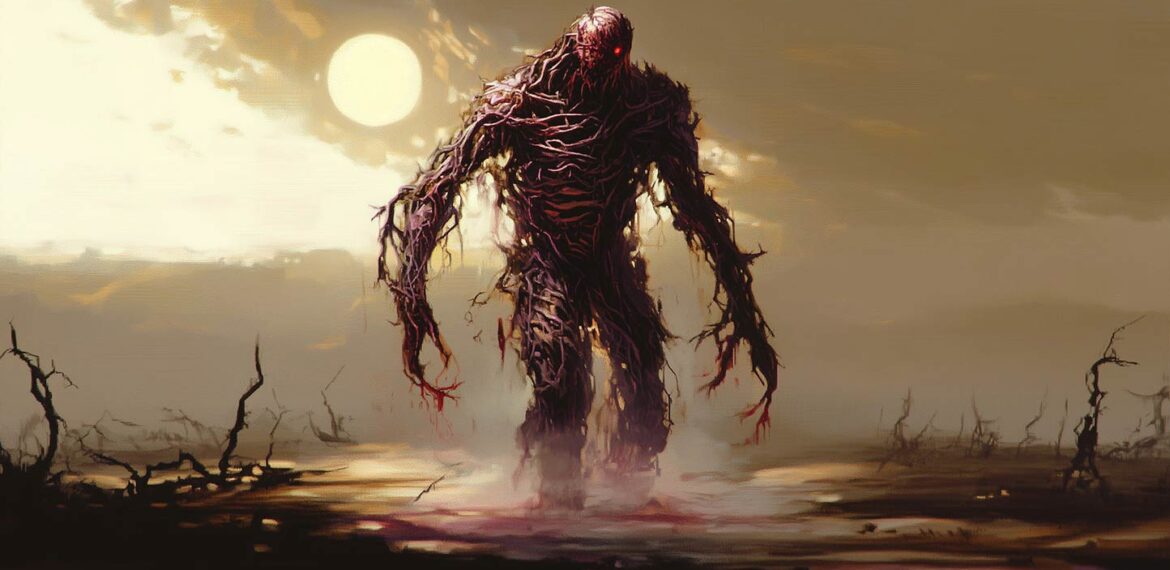
The Flesh Willow was a rare and fearsome monstrosity that once roamed the dense forests of the Wildlands, its existence whispered in the darkest corners of campfire tales. Towering at an imposing height of 18 feet, the creature bore a terrifying resemblance to a grotesque humanoid beast, its form warped by some cruel twist of nature or sorcery. Its leathery skin was a sickly beige color, stretched taut over bulging sinews and gnarled limbs. Deep fissures and scars marred its surface, as if the very forest had tried and failed to destroy it over countless centuries.
Physical Characteristics
Flesh willows resembled disgustingly-ugly, human-like giants composed of flesh, bone, blood and fleshy appendages that mimicked natural vegetation. Branches, twigs and even leaves could grow out from their fleshy bodies and often mirrored the appeareance vegetation of the forest they dwelled in, granting them camouflage amongst tall trees. The Flesh Willow’s most horrifying feature was its abdomen—a hollow cavity that served as a macabre prison for its prey. This grotesque maw-like cavity was ribbed with jagged, bone-like ridges and exuded a faint, nauseating stench of decayed flesh. The interior pulsated with unnatural life, its walls glistening with a mucous-like substance that clung to anything unfortunate enough to be trapped inside. Victims were often thrown into this fleshy prison, their screams muffled as the creature’s body sealed shut, leaving them to await their grisly fate. When ready, the Flesh Willow would extract its captives, crushing them into minced meat with either its colossal fists or the spiked tendrils that coiled within its hollow torso.

monstrosity
giant
80 years
huge
20'
8,000 lbs.
beige
yellow
none
The creature’s hands were massive, ending in jagged claws capable of cleaving through trees and stone with ease. Its arms were unnaturally long, giving it an extended reach in combat. While many Flesh Willows relied solely on their brute strength and claws to dispatch prey, some were known to wield enormous metal whips—crudely fashioned from the remnants of armor, chains, or weapons scavenged from their victims. These whips, often embedded with shards of bone and rusted steel, could rip apart flesh and leave deep, agonizing wounds.
Behavior and Hunting Tactics
The Flesh Willow was both a predator and a terror, moving with unnerving silence for a creature of its size. It stalked the shadows of the Wildlands, using the dense undergrowth and towering trees as cover. Despite its monstrous appearance, it displayed a cunning intelligence, often setting traps or ambushes for unwary travelers. It would mimic human cries or animal calls to lure prey deeper into the forest, where escape became impossible.
Once it had captured its victim, the Flesh Willow would imprison them in its hollow abdomen, allowing it to continue its hunt unburdened. Some scholars speculated that the creature took sadistic pleasure in prolonging its prey’s suffering, feeding on their fear and despair before delivering the final blow.
Origins and Lore
The origins of the Flesh Willow were shrouded in mystery, though numerous theories abounded among the scholars and sages of the Wildlands. Some believed the creatures were the twisted remnants of an ancient humanoid race, cursed by the gods for their hubris. Others posited that they were the byproduct of dark magic gone awry, created by an unknown sorcerer who sought to merge man and tree into an unholy abomination.
One of the most chilling legends spoke of the “Willow Pact,” an ancient ritual in which desperate mortals would beseech the forest spirits for power. Those who performed the ritual improperly would be consumed by the forest itself, their bodies transformed into Flesh Willows as punishment for their hubris. These cursed beings would forever roam the Wildlands, serving as a warning to those who dared to tamper with the balance of nature.
Weaknesses and Survival Stories
Though immensely powerful, the Flesh Willow was not invincible. Its leathery skin, while resistant to most weapons, could be pierced by enchanted blades or burned by fire. The creature’s hollow abdomen was also its greatest vulnerability; a well-placed strike to this area could rupture its internal structure, causing it to collapse in on itself in a grotesque and violent death.
There were rare tales of those who had survived an encounter with the Flesh Willow, often by exploiting its tendency to toy with its prey. One infamous story recounted the escape of a hunter named Kael, who, after being trapped in the creature’s abdomen, used a smuggled flint to ignite the gases within, causing the beast to explode from within.
Cultural Impact
The Flesh Willow became a symbol of dread among the denizens of the Wildlands. Its likeness was carved into warning totems placed at the borders of the forests, and its name was invoked in curses and prayers. Parents would use stories of the Flesh Willow to frighten children into obedience, warning them never to stray too far from the safety of the village.
In art and song, the Flesh Willow was often depicted as a manifestation of the Wildlands’ wrath, a reminder of nature’s untamable and ferocious power. Despite its fearsome reputation, some adventurers sought to hunt the creature, either for glory or the rare alchemical components rumored to be harvested from its remains. Its leathery skin, claws, and the viscous substance within its abdomen were said to possess potent magical properties, making it a coveted prize for alchemists and enchanters.
The Enduring Mystery
Even as the centuries passed and sightings of the Flesh Willow grew increasingly rare, its legend endured. Whether it was a singular, immortal being or a race of cursed creatures remained a topic of fierce debate. What was certain, however, was that the dense forests of the Wildlands still held their secrets, and those who ventured too deep risked becoming the next chapter in the chilling saga of the Flesh Willow.