
Morgrun’s Mantle towered over the Wildlands, a looming titan of fire and stone, its jagged peak forever wreathed in smoke. Rising only 1,100 feet into the sky, it was not considered a true mountain, as it stood much shorter. However, it was the most active volcano on the continent. Its ceaseless wrath poured forth in the form of molten rivers that stretched for miles, carving deep trenches through the charred terrain of central Hauth. The land around it trembled beneath the weight of its fury, its deep tremors sending shudders across the region. For centuries, it had been a fixture of legend, a force both feared and revered.
Despite its volatile nature, the village of Morgrun stood defiantly at its base, positioned opposite the endless lava flow. Here, nestled against the very foundations of the mountain, King Hauth’s castle loomed, a stark testament to mortal defiance in the face of nature’s might. It was said that the castle’s basalt walls had been forged from the cooled remnants of Morgrun’s own fury, shaped by artisans who had learned to bend the fire-gifted stone to their will.
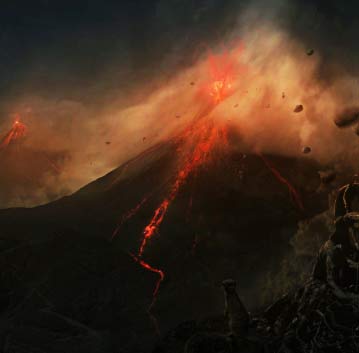
volcano
1,160 ft.
Central Hauth
The land surrounding the castle was oddly lush, for on this side of the volcano, the mountain’s violence gave way to an anomaly of nature—a vast, shallow lake of water named, The Sea of Salo, which shimmered against the towering blackened rock. No one knew why this water remained untouched by the fire that raged just beyond it, but some claimed it was a blessing from the Ides Pantheon, while others whispered of deeper, more ancient forces at work.
Beneath the smoldering heart of Morgrun’s Mantle, hidden within the vast and treacherous labyrinth of the Everdeep, lay the long-forgotten city of Seerathest. This subterranean metropolis had been built in 111 MA by the enigmatic fyreburhl, a reclusive and industrious people attuned to the heartbeat of the molten world. Within the volcanic caverns, they forged a kingdom of obsidian and brass, harnessing the raw power of the mountain’s fire to fuel their creations. Rivers of magma coursed through the streets like lifeblood, illuminating their great halls and furnaces with a ceaseless inferno.
For centuries, the fyreburhl thrived in their fiery domain, their mastery of heat and metal unmatched. But in 666 MA, darkness descended upon Seerathest in the form of the Inganar lords, a cruel and merciless faction of conquerors from the Deep Warrens. With relentless fury, they swept through the city, slaughtering the fyreburhl and claiming the burning depths as their own. For years, Seerathest burned—not from the mountain’s wrath, but from the cruelty of the Inganar. The great halls were blackened by blood and betrayal, and eventually, the city was abandoned, its charred bones left to crumble in the suffocating heat.
Yet, ruin was not the end of Seerathest. In 894 MA, the Inganar returned, accompanied by creatures of living flame that had slumbered in the farthest reaches of the Everdeep. The city was restored, its molten veins rekindled, and its halls filled once more with the echoes of life. It became a stronghold of fire and darkness, its denizens bound to the mountain’s hunger. The lava that flowed from Morgrun’s Mantle carried whispers of the city’s return, and those who ventured too close to the volcano’s depths often spoke of strange shadows moving within the flames.
Some say that Morgrun’s Mantle is no ordinary mountain. Legends tell of an ancient force that slumbers within its core, a being of pure fire and rage that once walked the land in an age long before the written word. The fyreburhl believed the volcano was the prison of a great infernal titan, shackled beneath the stone by the gods themselves. They named it Maldrak’kesh, the Bound Pyre, and built their city in reverence to its latent power. The Inganar, however, see it not as a prison but as a font of strength, and their return to Seerathest was said to be in preparation for the day when the titan awakens once more.
Even the people of Morgrun speak of the mountain with a mixture of awe and trepidation. Some believe King Hauth chose to build his castle at the base of the volcano not out of defiance, but out of necessity, as if the throne of Hauth itself was meant to keep watch over the smoldering beast. The waters of the great lake, untouched by the mountain’s fury, are believed to be the last safeguard against its awakening, though none can say why.
Morgrun’s Mantle is more than just a volcano—it is a harbinger, a monument to power and ruin, a place where history and myth intertwine in fire and shadow. Those who dare to walk its slopes know that they tread upon the edge of something ancient and terrible, and that, one day, the mantle may shatter, unleashing the inferno that has waited beneath it for untold millennia.