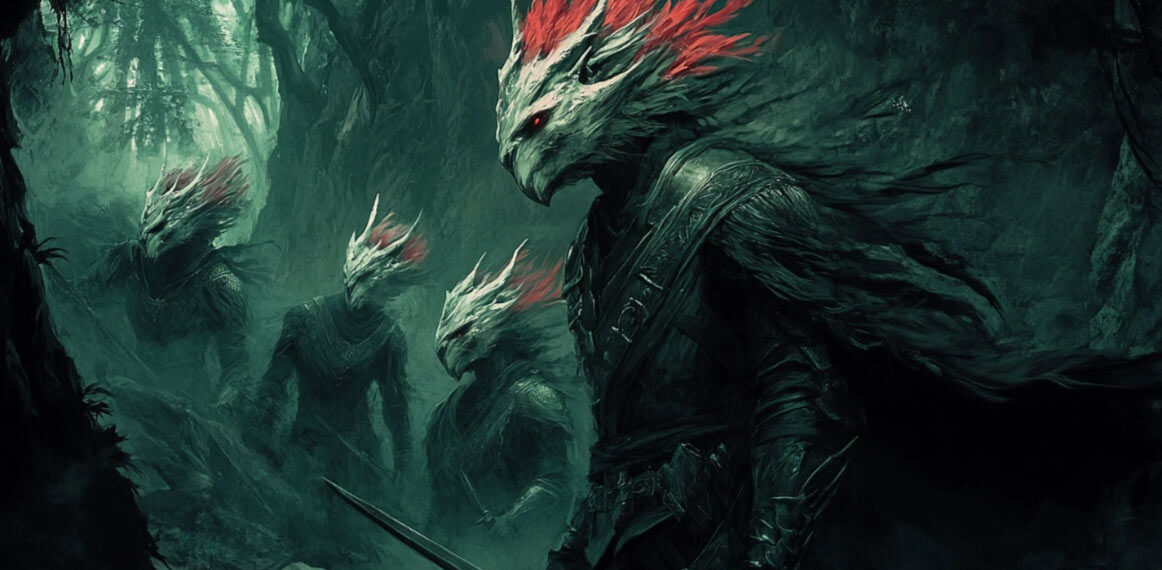
In ages long past, before the rise of the great cities and the age of stone towers, the Folken Birchal soared beneath the open skies of the Wildlands. Born of the same bloodline as the Ravan Birchal, they diverged in both spirit and purpose. Where the Ravan grew secretive, brooding in their moorlands and crafting hexes from bone and blood, the Folken turned their hearts to the canopy and the clouds. They became watchers, keepers of balance between earth and sky, and protectors of the ancient rhythms of the world.
The Folken Birchal were an avian-humanoid people, marked by their sharp, hawk-like features. Their humanlike faces bore long, beak-shaped noses, and their piercing eyes—grey, green, or a vivid sky-blue—could pick out a falcon’s flight from leagues away. Feathers, like crowns of rustling wind, swept back from their scalps and trailed down their shoulders and arms. These feathers shimmered with hues of gold, brown, and pale ash, blending perfectly with the forest treetops. The rest of their bodies, though human in form, bore a light beige skin, warm like sun-bathed bark.
Gliding
While the Folken lacked true flight like the majestic birds of the skies, they had the natural ability to glide across short distances. With a forceful jump and the extension of their feathered limbs, they could ride air currents, slipping silently through treetops or striking from above with deadly precision. Though not capable of long-range flight, their gliding prowess allowed them to navigate challenging terrain swiftly and silently, proving invaluable in combat.
Keen Senses & Tracking
Like the Ravan, they too were blessed with exceptional sensory perception, the Folken had an uncanny awareness of their environment that set them apart from most creatures. Their sharp vision enabled them to detect threats or prey from afar, and their refined instincts made them expert trackers. Even the most subtle signs of movement or the faintest scent trail rarely escaped their notice. Their finely tuned hearing further enhanced their awareness, allowing them to pick up the slightest sounds—making them nearly impossible to surprise or ambush.
Homelands
Their largest enclaves rose from the wild forests of Vüdos, where the trees grew tall and old and the winds carried the songs of the ancients. In T’ssara, they claimed the highland groves, building hanging cities between towering birches and evergreens—vast arboreal complexes of ladders, rope bridges, and wood-slat platforms that swayed with the breeze. Ardessmus, the southernmost reach of Folken habitation, lay along the edge of the Cloudrun Peaks, where the Folken trained their most elite windriders—warriors who leapt from cliffs with glider-like wings, patrolling the sky-lanes and safeguarding the mountain paths.
The Folken Birchal were not merely skilled warriors but also philosophers, lorekeepers, and storm-readers. They believed that the wind carried the whispers of the dead and that the stars were the eyes of sky-spirits watching over the natural order. They held council in great rookeries called Thalara, where elders—called Skybinders—would interpret cloud-signs, bird migrations, and forest omens. These councils governed their cities through consensus and were revered as much for their wisdom as for their martial discipline.
In battle, the Folken fought with a grace and precision that mirrored the predatory birds they studied. Light armor of leather and bark adorned them, and they wielded curved talon-blades and longbows of whitewood. Their vision allowed them to track movement faster than most eyes could register, and they struck with swift, aerial cunning.
But for all their harmony with nature, the Folken Birchal bore a shadow in their lineage—their kin, the Ravan Birchal, with whom they shared a complex and often strained coexistence. The Ravan, steeped in occult traditions and dwelling in darker marshlands and under-canopies, frequently clashed with the Folken over matters of territory, ideology, and blood-feud. Some Ravan were welcomed in Folken rookeries, especially those who turned from the darker paths, but tensions always simmered. In times of peace, the two subraces traded knowledge and even intermingled. In times of strife, war broke out in tree-shadowed glades, where spell met blade and storm met hex.
Still, the Folken endured, rooted as much in the sky as in the trees. They viewed themselves not as conquerors but as custodians, tasked with maintaining the harmony of the Wildlands. They held no empires, carved no stone roads, and built no monuments. Their legacy was written in the wind, sung through the leaves, and painted across the morning skies where hawks soared and the sun crowned the trees.
In a land where beasts prowled and gods slept beneath roots and rivers, the Folken Birchal remained vigilant—eyes to the sky, hearts in the trees, and blades ever sharp.
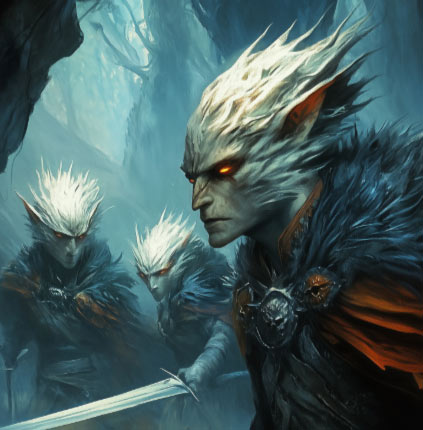
medium
5'10"
beastial humanoid
80-90 years
neutral or chaotic good
Animas Pantheon
shades of beige
white, orange, brown or beige.
grey, blue or green
mountain, grassland, forest, marsh