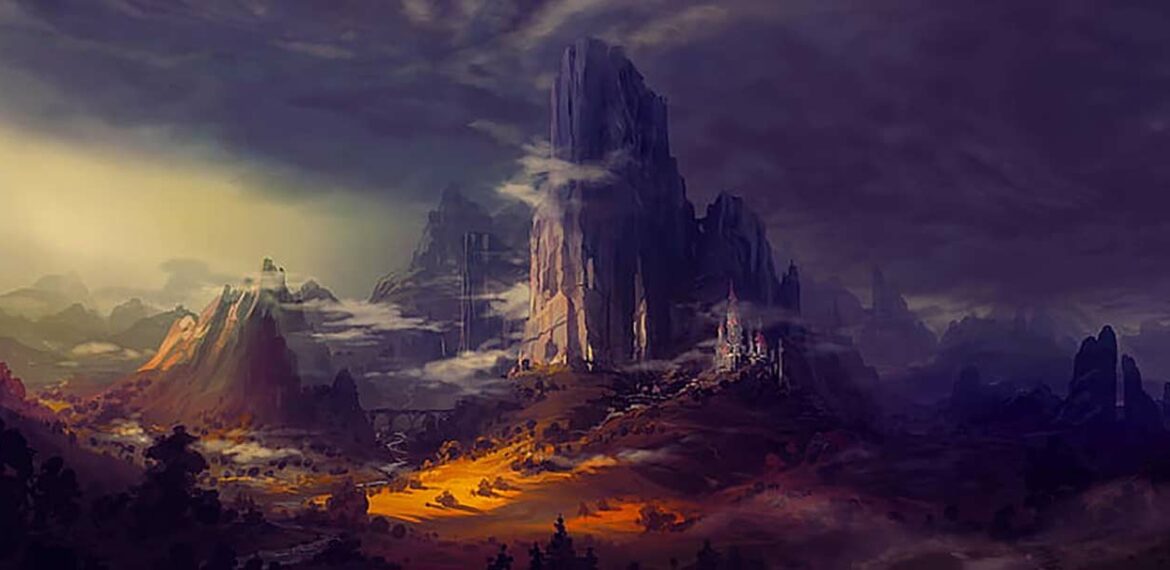
The Wildlands of Eos
The Wildlands, one of only two continents on the surface of Eos, was a vast, rugged land steeped in ancient histories, mysteries, and perils. Spanning nearly two-thirds of Eos’s surface, the Wildlands held diverse terrains, climates, and ecologies, each shaped by ages of elemental forces and mythic events. From the frozen reaches of Antara in the north to the subtropical forests of the southern shores, the Wildlands drew adventurers, mystics, and conquerors alike, all seeking its hidden power and secrets. Though fierce storms, volcanic eruptions, and territorial beasts made survival a test of wit and resilience, tales of the Wildlands’ wonders—and its dangers—spread across continents and generations.
Geography
The terrain of the Wildlands was a chaotic tapestry of extreme environments, shaped by powerful forces and ancient magics that lay dormant or volatile within the earth. With towering mountains, endless plains, and dark deserts, the Wildlands offered some of the harshest and most breathtaking landscapes known. Different regions held distinct climates and geological features, each with its own history and legends, as though Eos itself whispered the secrets of these lands to those who could listen.

continent
6,000 sq. miles
17 million
North: Antara, the Icelands
The northern reaches of the Wildlands, known as Antara, were a haunting expanse of tundra and glacial ice. Antara was a land of unrelenting cold, where the wind howled like spectral voices across miles of icy wilderness. This region, with its endless frozen plains and towering ice walls, was home to the ancient Nordisa people. They navigated the perilous icefields by following paths mapped in songs and lore, as the treacherous terrain shifted constantly with the drifting glaciers and shifting northern winds. The large ice cap in central Antara held mysteries that few dared approach: old stone shrines, believed to be the remains of a lost civilization, were partially encased in ice, each marked with strange runes. Some Alana mystics believed these stones held ancient power, and legends told that under the right moon phase, faint singing could be heard resonating from them. Few ever returned from expeditions to the ice cap, and those who did were often haunted by visions they could scarcely understand, tales of frozen spirits and ghostly figures who watched from afar.
South: The T’ssara’s Verdant Shores & Subtropical Mystique of Vüdos
In stark contrast, the southern Wildlands harbored subtropical jungles and lush forests that ran along the eastern seaboard and the shores of the T’ssara Strait. This region was teeming with life and vibrant greenery, where vines thick as tree trunks twisted through dense canopies, and strange beasts roamed under the cover of shadowed groves. Stories told of Alana sages who ventured south, seeking out rare herbs that could heal even the deadliest wounds. Some even believed that deep within these dense forests lay the mythical Tree of Elaran, said to grant visions of the past and future to those who drank from the sap of its bark. Explorers who ventured too far, however, often met untimely fates, encountering dangerous creatures that had never been seen outside the Wildlands. Even the Grey Gor avoided the depths of the T’ssara forest, steering clear of lands rumored to be protected by spirits and druidic magic. Here, the air itself seemed enchanted, the humidity heavy with the scent of blooming flowers, creating an intoxicating haze that often lured travelers deeper, sometimes never to return.
Vüdos was a land of contrasts, where untamed natural beauty blended with a thriving, maritime nation-state. Lush jungles met sprawling savannas, and the coastlines, lined with towering palms, carried the scent of saltwater. Inland, ancient forests held unique flora and fauna, nourished by tropical rains and a network of rivers that sustained the vibrant wildlife. Dominating the horizon, Mt. Vekuo, the continent’s second-largest active volcano, loomed as a powerful reminder of the land’s raw, elemental forces.
Central: The Blackwarg Desert
At the heart of the Wildlands lay the Blackwarg, a dry, arid desert unlike any other on Eos. Its earth was not the tan or brown of most deserts, but a deep, coal-black color, giving the region an unsettling and eerie quality. The Alana believed this soil had been darkened by ancient fire-magic used in forgotten wars, creating a land scorched by elemental power. The Blackwarg was scattered with ruins of unknown origin, partially buried in the black sand, where wandering mystics reported hearing strange, whispering voices at night. This place was a battleground for magic itself, the air thick with residual energy, drawing mages from across Eos to test their skills and connect with its power. The Alana called it “Veinland,” believing that the region was crisscrossed by magical veins running through the black earth, containing remnants of arcane energy. However, the Veinland’s power was volatile and dangerous to all but the most skilled arcana practitioners.
East: The Fiery Peaks of Morgrun’s Mantle
The eastern Wildlands were dominated by the vast, semi-arid plains and mountain ranges marked by hues of dark red and brown, shaped by the powerful volcanic force of Morgrun’s Mantle, an active volcano and one of the Wildlands’ most dangerous natural features. Morgrun’s Mantle erupted frequently, its molten rivers flowing down to stain the earth below. The Grey Gor, known for their War Magic, believed Morgrun’s Mantle to be a sacred mountain, an elemental source that fueled their powers. Legends held that the Twilight Sect would journey here to meditate, watching the lava flows, and seeking visions in the fiery eruptions. The Alana regarded it as an unpredictable place, a land where the boundary between the physical and elemental worlds grew thin, and some said that the spirits of ancient sorcerers were trapped within its fiery depths.
West: The Pillars of the Verdanas Mountains and the Denari Desert
The western Wildlands were a realm of imposing beauty, where colossal mountain ranges known as the Verdanas Mountains stretched for hundreds of miles, marking the highest peaks on the continent. Here, the Alana found their home, building fortified cities in natural caverns and connecting them by winding paths only they knew how to traverse. These mountains were considered holy, said to be infused with the energy of an ancient power that Alana sages meditated upon. But to the far southwest lay the Denari Desert, a flat, arid expanse that seemed endless and untouched. Though bleak, the Denari held relics of the past—old statues and shrines, partially buried in sand, dating back to the time of the Palpate of Sages. These were said to mark the burial sites of ancient Alana warriors and mystics who protected the Wildlands from dark forces during the earliest ages. Today, the Denari Desert was home only to the fiercest nomadic tribes and wandering Grey Gor, whose legends claimed that the spirits of fallen Alana still watched over the desolate sands, protecting it from trespassers.
Each region of the Wildlands held mysteries and dangers that told the stories of an ancient world, where the past still whispered through windswept plains, icy tundras, and enchanted jungles, binding the Wildlands in an endless cycle of life, magic, and legend.
Map of the Wildlands (2850 x 2500 px.) (Click to enlarge)
