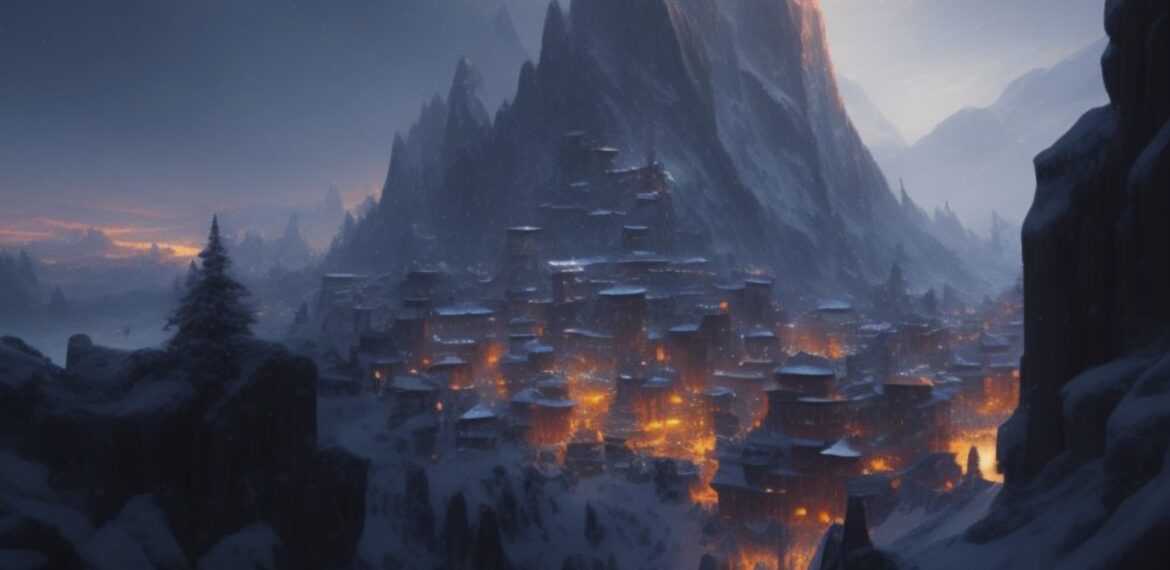
Farric was a deeply druidic village, steeped in the Fyreburhl’s sacred rites and reverence for the natural world. Most of its structures were carved from fine redwood, skillfully hewn and etched with intricate patterns depicting fire and earth symbols, a nod to the elemental magic that sustained both the town and its people. This redwood, chosen for its strength and unique warmth, lent each building a reddish, earthen hue, which, in the firelight, made the entire town glow with an ethereal vibrance. With carved doorways and statues that honored the great beasts and elemental forces, every home and hall felt like a shrine to the wild spirit of Zor.
At the heart of Farric stood massive ironwood trees, ancient giants whose twisting branches and sturdy trunks were revered by the Fyreburhl as sacred. These ironwoods were more than trees—they were icons, presences that the villagers believed held the wisdom of their ancestors. Each tree’s base was ringed by stone benches, forming natural sanctuaries where druidic rituals were performed in every season. Beneath the sprawling branches, the Fyreburhl gathered to chant and meditate, calling on the spirits of nature for guidance, protection, and the renewal of their bond with the land. These gatherings, filled with song, firelight, and rhythmic drumming, imbued Farric with an atmosphere of quiet magic, as if the village itself pulsed with life from the earth below.
The streets of Farric were adorned with bundles of snowbrush, sage, and pine, each chosen for its connection to winter and the spirit of endurance. Even in the coldest months, these plants added a touch of color and fragrance to the village, their resilient greens standing out against the deep snow and redwood hues. In the winter, these aromatic herbs and shrubs gave Farric an air of quiet liveliness, as if the plants themselves were welcoming the season’s chill with calm acceptance. The streets, though winding and narrow, were always bustling with activity, filled with villagers in cloaks of fire-dyed wool, their voices mingling with the crackle of torches.

Farric
the hearth
Zor
6,000
dry, mountain
fyreburhl, gor, humans (nordisa, alana), jurell (ashen, earthen)
village
archdruid Elmïr
Among the Fyreburhl, winter wolves held a special place of honor. These magnificent, snow-coated animals, both fierce and intelligent, had become trusted companions to the people of Farric. They were trained from pups to serve as loyal pets and fierce protectors, moving alongside the village guards who patrolled the streets. These wolves, with their thick white coats and intense amber eyes, lent a mystical presence to the town, roaming alongside the Fyreburhl as quiet sentinels. Known for their loyalty, winter wolves often guarded the ironwood trees during sacred gatherings, where they sat in attentive silence, as if drawn to the natural energies summoned by the Fyreburhl druids.
The Hearthcrest Tower, located in the nearby village of Hearthcrest, not only warmed the town but also served as a symbolic heart of the Fyreburhl’s druidic devotion. Built from stone imbued with the Fyreburhl’s sacred fire magic, the tower emitted a steady warmth throughout Farric and the surrounding lands. This warmth served as a gift from the land itself, a reminder of the Fyreburhl’s unique bond with the volcano’s magma pool deep beneath the mountain.
Farric was a village where every detail held meaning, every flame had purpose, and every living creature had its place. It was more than a settlement; it was a sanctuary that reflected the power and reverence of the Fyreburhl’s druidic ways. Cloaked in winter’s icy embrace yet warmed by the Hearthcrest Tower, Farric stood as a place where fire and frost, nature and magic, wove together in perfect harmony. Its people, guardians of both flame and forest, had created a haven of resilience, beauty, and elemental strength—one that echoed with the ancient songs of ironwood trees, the howls of winter wolves, and the quiet crackle of endless fires.
Hall of Zor
The Hall of Zor stood as a massive stone fortress, perched high on the village ridge along the sheer cliffs of the Windstross Mountains. It was one of the most important landmarks in all of Zor. Here, the high druids of the Fyreburhl and the village lords convened in solitude and authority to deliberate on all matters related to both Farric and Zor as a nation state. Ancient ironwood pine trees framed the hall, towering like sentries, while ornately carved stones adorned the grounds, each marked with symbols of fire and earth. Within its heavy stone walls, the hall echoed with druidic chants and the low hum of ancient rituals, a solemn space where the elements and the spirit of Zor merged into one timeless presence.
Notable Locations
Hearthcrest Post
The Hearthcrest Post lay hidden beneath Farric, a winding underground network where heat from the Hearthcrest Tower above was channeled and distributed through molten channels carved in the stone. The air shimmered with warmth, and waves of heat pulsed through the cavernous passages, making it a sweltering maze that only the fire-resistant could withstand. Along the narrow paths, pillars of rough volcanic rock supported the low ceiling, flickering with the red glow of the lava beneath. The Fyreburhl who ventured here did so with reverence and caution, carrying out sacred tasks to ensure the warmth flowed steadily. Strange mineral formations, born from the mingling of earth and fire, sparkled in the orange light, creating an ethereal, almost otherworldly effect that made Hearthcrest Post as mesmerizing as it was perilous.
Ironwood Glade
Ironwood Glade was a mountainous enclave that felt both majestic and timeless, surrounded by towering ironwood trees whose thick, gnarled branches formed a natural canopy over the space. The trees’ dark, rugged bark and silvery leaves shimmered under the sunlight that filtered through the heights of the canopy, lending a quiet grandeur to the place. Smooth stones encircled each ironwood tree like benches, forming places for villagers to sit during gatherings, where the Fyreburhl orators and lords would address the community. In this revered space, where each ironwood had stood for hundreds of years, the people gathered to share tales, make decisions, and celebrate their bond to the ancient land. The ground was often blanketed in pine needles and sage, filling the glade with earthy, fresh aromas, and when the winter snow dusted the branches, the glade became an enchanting mix of frost and shadow.
Uvarius Point
Uvarius Point was a lookout built upon a steep cliffside at the village’s edge, offering a sweeping view of Farric below. From this height, guards kept a close watch, scanning the forest borders and mountain paths for any sign of danger. The cliff edge, rugged and bare, jutted out over a steep drop to the trees below, with a narrow stone railing marking its perimeter. To one side, a lone ironwood tree grew resiliently from the rocks, its roots wrapped tightly around the cliffside, as if anchoring itself against the winds that swept over the point. The view from Uvarius Point was unparalleled—by day, guards could see the curling paths of smoke from the village fires, the twinkling lights of the marketplace, and the Hearthcrest Tower in the distance. By night, the village glowed like a constellation against the darkened forest, and the guards, cloaked in furs, stood vigil under the stars.
Farric Market
The Farric Market was a lively, sprawling affair, an open-air market filled with rows of wooden stalls and makeshift tents that stretched along the central village path. Blanketed in snow for much of the year, the market had an almost festive feel, with paths lined by torches that flickered through the wintery fog. Stalls overflowed with goods from across Zor and beyond: fur-lined cloaks, fire-forged iron tools, colorful jars of dried herbs, and trinkets carved from volcanic stone. The sharp scent of pine and roasting meats filled the air, as did the lively hum of conversation and laughter. Merchants haggled good-naturedly with customers, and Fyreburhl artisans showcased their craft, from woven charms to fire-infused amulets. Children dashed between the stalls, and even the trained winter wolves lounged around the market, adding a protective yet familiar presence. In the crisp winter air, the Farric Market was a place where the community gathered, traded, and celebrated the simple joys of life amid the chill and warmth of their mountain home.